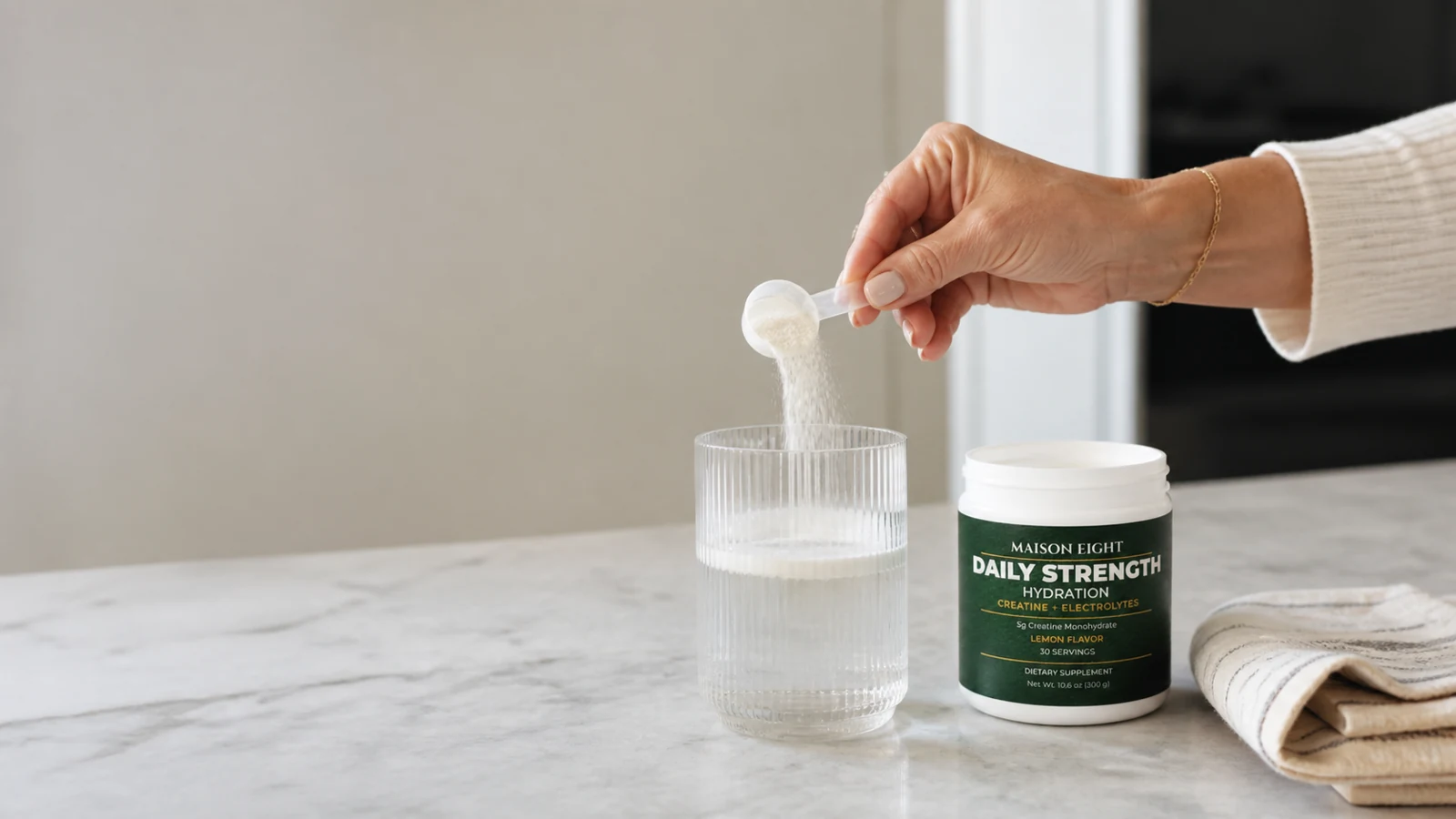
You can mix creatine monohydrate into coffee, but coffee is a routine choice—not a proven absorption upgrade. Heat helps creatine dissolve, while time in a warm, acidic liquid can make dissolved creatine less stable. The practical approach is to mix it when you are ready to drink it, stir again if powder settles, and count the coffee's caffeine separately. [1] [2]
Published October 5, 2026 · Updated October 22, 2026
The useful question is not simply whether creatine and coffee can share a mug. It is whether that mug helps you take the full serving consistently without turning uncertain caffeine research into a stronger claim than the evidence supports.
Creatine in coffee: the quick answer
| Question | Practical answer |
|---|---|
| Can you mix them? | Yes. Creatine monohydrate has been administered in hot tea in research, and warmer liquid increases its solubility. |
| Does heat instantly destroy creatine? | No. Dissolved creatine is less stable at higher temperatures and lower pH, but the evidence does not establish that an ordinary freshly mixed cup becomes ineffective. |
| Does caffeine cancel creatine? | Current human studies are mixed. They do not support a simple universal rule that coffee cancels creatine or that the combination is superior. |
| What matters most? | The full creatine serving, total daily caffeine, your tolerance, and whether you actually drink the settled powder. |
Does hot coffee destroy creatine?
Not instantly. Creatine monohydrate powder is stable in dry storage. Once dissolved, creatine can gradually convert to creatinine, and that conversion is faster at higher temperatures and lower pH. A 2021 scientific review also notes that warmer liquid increases creatine's solubility and that early studies administered creatine in hot tea. Better solubility did not improve tissue uptake. [1]
Those facts support a narrow practical conclusion: hot coffee can be a mixing vehicle, but it should not be treated as long-term storage for a prepared creatine drink. The research reviewed here does not provide a coffee-specific countdown or an exact percentage lost from one cup. Claims that a normal mug either destroys all creatine or preserves exactly 100% go beyond the evidence.
If you use coffee, add creatine near the time you plan to drink it rather than preparing a hot thermos hours ahead. Iced coffee is also an option; colder liquid may dissolve the powder less readily, so stir or swirl again before the last sip.
Does creatine need to dissolve completely?
No. Creatine monohydrate does not need to make a perfectly clear drink before you consume it. Its limited water solubility means some powder can remain suspended or settle, especially in a small amount of cool liquid. A clearer drink may feel smoother and make the whole serving easier to finish, but greater solubility has not been shown to improve creatine uptake into tissue. [1]
A crossover study in 17 healthy young men compared 2g of creatine in an aqueous solution with the same amount incorporated into protein- or beta-glucan-rich food bars. The food bars slowed the absorption rate, but the overall blood exposure was not different, the increase measured in red blood cells was similar, and no creatine or creatinine was detected in the limited fecal samples. That study did not test gritty sediment in a glass, women or Daily Strength Hydration, so it cannot prove that every mixing method is identical. It does show why faster appearance in blood should not be confused with more complete absorption. [6]
The practical issue is dose delivery, not visual clarity. Stir or swirl before the last sip, add a small rinse of liquid if powder remains, and finish the measured serving rather than adding another scoop. Follow the product's directions; ingredient research about plain creatine monohydrate is not a mixing or absorption test of a finished flavored formula.
Does caffeine interfere with creatine?
The most accurate answer is the performance evidence is mixed and depends on the protocol studied. A 2022 systematic review included ten studies. Acute caffeine after a creatine-loading period did not consistently interfere with caffeine's performance effect, while studies of chronic caffeine taken during creatine loading reported conflicting results: some found interference, others no interaction, and one reported synergy. [2]
A separate systematic review of ten studies also found inconsistent outcomes. Some trials reported an additional performance effect when caffeine was taken after a creatine-loading period; daily caffeine during loading was less consistently additive. The reviewed protocols often used loading doses and caffeine measured in milligrams per kilogram, so they are not a direct test of every person's ordinary morning coffee routine. [3]
That means the evidence does not justify either extreme:
- “Coffee cancels creatine” is too certain.
- “Coffee makes creatine work better” is also unsupported.
- A convenient combined routine can be reasonable, but separate use is equally reasonable if caffeine, taste or stomach comfort makes the mug harder to tolerate.
Count the caffeine, not just the cup
Coffee servings vary in size and caffeine content. The FDA says 400mg of caffeine per day is an amount not generally associated with negative effects for most adults, while emphasizing that sensitivity, medications and medical conditions can change what is too much. Pregnancy and breastfeeding require different guidance. [4]
Count coffee alongside pre-workout, tea, energy drinks and other caffeinated products. Creatine itself is not caffeine and does not create an immediate stimulant effect. If a combined coffee-and-creatine routine contributes to jitteriness, sleep disruption or stomach discomfort, moving creatine to a non-caffeinated drink can simplify the question without changing the purpose of a daily creatine routine.
How to mix creatine into coffee
- Use the labeled serving. Measure the product as directed. Do not add an extra scoop because some powder remains visible.
- Mix it when you are ready to drink. Avoid treating a prepared hot drink as an all-day storage container.
- Stir thoroughly. Warmer liquid can improve solubility, but undissolved powder may still settle.
- Check the last sip. Swirl or stir again so the portion at the bottom is not routinely left behind.
- Count overlapping ingredients. If the creatine product includes electrolytes, caffeine, sweeteners or other ingredients, assess the whole label rather than the creatine line alone.
Do not infer better absorption from a clearer-looking drink. Dissolving more completely can improve texture and help you consume the full serving, but the 2021 review did not find that greater solubility improves tissue uptake. [1]
Can you mix creatine ahead of time?
A bottle prepared for later the same day is a different question from a shelf-stable ready-to-drink product. Creatine monohydrate is stable as a dry powder, but once it is dissolved, time, temperature and pH all affect how quickly some creatine converts to creatinine. Neutral solutions are more stable than acidic ones, and colder storage slows the change. [5]
Laboratory data are measured over controlled conditions and usually over days, not every possible kitchen recipe. They support a practical hierarchy rather than a universal expiration clock:
- Best default: keep the powder dry and add liquid when you are ready to drink it.
- If you prepare it early: keep the drink cold, follow the product's storage directions, and consume it promptly rather than carrying it across multiple days.
- Be more cautious with acidic or warm drinks: lower pH and higher temperature speed degradation in solution.
- Do not confuse chemical stability with food safety: a shake containing milk, protein or other perishable ingredients also has storage limits that creatine research does not answer.
This evidence does not establish an exact overnight guarantee for every flavored creatine blend. Daily Strength Hydration contains creatine, electrolytes, flavoring and other ingredients; ingredient-only stability research is not finished-product shelf-life testing. Follow its label when available rather than borrowing a time limit from plain creatine in laboratory water.
When might separate drinks make more sense?
Using water or another non-caffeinated drink may be simpler when:
- you sip one coffee slowly over several hours;
- you often leave sediment in the mug;
- coffee plus supplements worsens stomach discomfort;
- you need to reduce or track caffeine precisely;
- your coffee routine changes from day to day; or
- a clinician has advised you about caffeine, kidney function, medication interactions or supplement use.
This is a routine decision, not a rule that creatine must be separated from coffee. The owning principle remains consistency: take the intended creatine amount in a way you can follow and tolerate.
How this fits with timing and pre-workout questions
Coffee does not create a special creatine timing window. The current timing evidence does not establish that women need creatine immediately before or after exercise; the women-over-40 timing section owns that question.
Coffee also does not turn creatine into a pre-workout stimulant. For the difference between creatine, electrolytes and products that may contain caffeine, use the creatine, electrolytes and pre-workout comparison. For the underlying ATP and muscle-store mechanism, see what creatine actually does.
Where Daily Strength Hydration fits
Maison Eight Daily Strength Hydration lists 5g of creatine monohydrate plus sodium, potassium and magnesium in a lemon-flavored powder. It does not list caffeine and is not positioned as a stimulant or caffeinated pre-workout.
Follow the product's labeled mixing directions and review its formula, Supplement Facts and current availability. Daily Strength Hydration is temporarily unavailable. Joining the waitlist requests availability updates; it does not place an order or reserve inventory.
The bottom line
Creatine can go in coffee if that is a convenient way to take the full serving. Mix it near the time you will drink it, stir again if it settles, and do not claim that heat improves absorption.
Caffeine and creatine performance studies remain mixed, especially across different loading and co-ingestion protocols. Coffee does not need to be prohibited, and it should not be promoted as a creatine enhancer. The better routine is the one that fits your caffeine tolerance, stomach comfort and consistent use.
Sources
Sources checked October 22, 2026. Written by Maison Eight. Ingredient research discussed here is not a clinical trial of Daily Strength Hydration.
- Antonio J, et al. Common questions and misconceptions about creatine supplementation: what does the scientific evidence really show? Journal of the International Society of Sports Nutrition. 2021;18:13.
- Elosegui S, et al. Interaction Between Caffeine and Creatine When Used as Concurrent Ergogenic Supplements: A Systematic Review. International Journal of Sport Nutrition and Exercise Metabolism. 2022;32(4):285–295.
- Vasiliadis A, et al. Effects of creatine and caffeine ingestion in combination on exercise performance: a systematic review. Critical Reviews in Food Science and Nutrition. 2023;63(28):8998–9007.
- U.S. Food and Drug Administration. Spilling the Beans: How Much Caffeine is Too Much? Adult caffeine context and individual sensitivity.
- Kreider RB, et al. Bioavailability, Efficacy, Safety, and Regulatory Status of Creatine and Related Compounds: A Critical Review. Nutrients. 2022;14(5):1035. See the solution-stability discussion on pH, temperature and time.
- Deldicque L, et al. Kinetics of creatine ingested as a food ingredient. European Journal of Applied Physiology. 2008;102(2):133–143. Seventeen healthy young men; aqueous solution versus two food-bar matrices.