-
Last updated: September 26, 2026
No. You do not need to work out to take creatine. If you already use it as part of a training routine, a rest day does not require a skipped dose or special timing. If you do no resistance training, your muscles can still take up supplemental creatine, but the clearest evidence for muscle and strength benefits involves creatine alongside resistance training—not as a replacement for it. [1] [2] [3]
That distinction matters whether you are taking a rest day, on a temporary break from training, mainly walking, or wondering whether a supplement is worth adding before you have an exercise routine.
Being able to take creatine and having a strong reason to take it are different questions.
Taking creatine without working out: three different situations
How your routine changes the answer Your situation What to know You exercise regularly but are taking a rest day A usual daily creatine routine can continue. Every dose does not need a matching workout. You stay active but do not go to a gym A gym is not required. Home resistance exercises count, but walking and errands are not equivalent to a structured strength program. You do no resistance training Creatine stores can still increase. Meaningful muscle and strength benefits are less certain. These distinctions reflect creatine research and the difference between aerobic and muscle-strengthening activity. [2] [3] [6]
Why exercise is not required for creatine to enter muscle
Your body already uses creatine. Inside muscle, some is stored as phosphocreatine, which helps rapidly rebuild ATP. ATP is a molecule cells use to supply energy for work, including muscle contraction. [3]
Supplementation can increase the amount of creatine stored in muscle. Exercise can influence uptake, but a workout is not an on-switch that makes creatine absorbable. Foundational human research examined creatine accumulation in both resting and exercised muscle. [1]
The important limit is that increasing a stored compound does not automatically prove a noticeable improvement in strength, stamina or everyday energy.
For the fuller explanation, read what creatine actually does.
Will creatine build muscle if you never strength train?
Do not count on creatine alone to build substantial muscle.
A 2022 systematic review found that adding creatine to resistance training increased lean body mass on average. In its subgroup of trials without exercise, creatine did not produce a statistically significant increase. This is evidence of a less reliable benefit without training, not proof that no individual can ever benefit. [2]
There is also direct evidence in older women. A two-year trial assigned 200 postmenopausal women with osteopenia, a condition involving low bone density, to 3 g of creatine daily or placebo. Creatine did not add benefits for lean mass or muscle function. These findings apply to that population and protocol, not automatically to every woman over 40. [4]
Also, lean mass is not the same as newly built muscle tissue. Body-composition measurements include water, and creatine-related water changes can influence the result. [10]
What about newer studies showing benefits without exercise?
A trial published online in August 2026 reported improvements in lean tissue, strength and muscular endurance without an exercise intervention. It analyzed 64 adults aged 45–65, including 40 women, after 12 weeks at 10 g daily. [5]
However, participants chose their exercise status; only supplement assignment was randomized. The study was small and used more than a usual maintenance dose. It is an encouraging finding, not proof that 5 g daily replaces training or reliably produces the same results in inactive women. [5]
Do women need gym workouts to benefit?
No gym membership is required for resistance training. Resistance bands, weights and exercises using your own body weight can all challenge muscle. The CDC recommends muscle-strengthening activity on at least two days per week, alongside aerobic activity. [6]
The relevant distinction is the kind of challenge, not the building where it happens. An appropriately challenging home routine belongs in the strength-training conversation.
In a randomized trial involving older women, creatine combined with resistance training improved some measures of strength and lean mass more than creatine alone. Additional benefits were not identical across every strength test. [7]
Walking is worthwhile activity. But research involving progressive resistance training should not be repackaged as proof that creatine makes ordinary walks or household errands easier. [6] [7]
Our guide to creatine for women over 40 explains why the population studied matters.
Should you take creatine on rest days?
For a standard daily supplementation routine, yes. Taking creatine on rest days helps maintain muscle stores; it is not a dose that must be used up during that afternoon's workout. [3]
For example, training on Monday and Thursday does not require a different creatine schedule on Wednesday.
Missing an occasional dose does not empty your muscles of creatine overnight. Stored levels decline gradually after supplementation stops. Resume your usual routine rather than doubling the next dose to compensate. [11]
Can creatine help your brain without exercise?
Possibly, but this is not a settled reason for everyone to supplement.
A 2026 review of cognition in older adults found encouraging associations, but four of its six studies were observational studies of diet. Only two were supplementation interventions. An association between food intake and test scores cannot establish that taking a supplement causes the benefit. [8]
A separate scientific assessment by the European Food Safety Authority concluded that the evidence it reviewed did not establish a cause-and-effect relationship between creatine supplementation and improved cognition. [9]
Brain-health research remains worth following. It does not justify promising sharper thinking, relief from brain fog or menopause-symptom treatment from a daily scoop.
Will creatine turn into fat if you do not work out?
No. That is not how creatine works. It is not unused workout fuel that automatically becomes body fat when you skip exercise. [10]
What can change is water storage. Some people notice a higher scale weight after starting creatine, particularly with loading. That is not necessarily fat gain or newly grown muscle.
Others notice little change. It would be inaccurate to promise either universal weight gain or no bloating and no water-weight changes. [10]
How much creatine do you take without working out?
Common daily supplementation protocols use 3–5 g of creatine monohydrate. That is a range used to build or maintain creatine stores, not proof that every inactive adult needs a supplement. There is no reason to increase the dose to make up for not exercising. [14]
You do not need a loading phase
Loading raises muscle stores more quickly, but smaller daily amounts work more gradually. In a foundational study in men, 3 g daily for 28 days increased muscle creatine without loading. This was a tissue-storage study, not proof of strength gains in women who do not exercise. [11]
Choose a repeatable time rather than organizing your day around a workout window. The point of a daily protocol is maintaining stores.
You do not need protein powder
Creatine is not dietary protein. Protein powder is optional; what matters nutritionally is getting adequate protein overall. Taking creatine does not replace that need. [14] See how creatine and protein do different jobs.
Is taking creatine without exercise safe?
Creatine monohydrate is generally well tolerated in healthy adults. Whether it suits you depends more on your health, dose and the full product formula than on whether you exercised that day. Some people experience stomach discomfort or diarrhea, particularly with larger single doses. [12]
Controlled research does not support the claim that ordinary creatine use causes dehydration. That does not remove the need for appropriate fluid intake, and it does not mean everyone needs an electrolyte supplement. [12]
Tell your clinician before kidney testing
Creatine can affect blood creatinine, a marker used in some kidney-function calculations. A 2026 meta-analysis found changes in creatinine-based estimates without matching evidence of reduced filtration using a direct measurement method. An abnormal result still needs proper clinical interpretation; it should not automatically be dismissed as a supplement effect. [13]
Get individual guidance before starting if you have kidney disease, abnormal kidney tests, fluid or mineral restrictions, take relevant medications, or are pregnant or breastfeeding. If injury or illness is keeping you inactive, follow your care plan rather than assuming creatine will prevent muscle loss.
Is it worth taking if you do not exercise?
Start with your goal, not the supplement.
For improving strength: prioritize an appropriate strength routine and adequate nutrition. Creatine can be an optional addition, rather than the starting point for everything else. [2] [7]
For a temporary break: continuing a usual daily protocol is different from expecting creatine to replace all the benefits of movement.
For general wellness without training: the expected payoff is less certain. Choosing not to take it is reasonable, especially when there is no clear outcome you are trying to improve.
Where Daily Strength Hydration fits
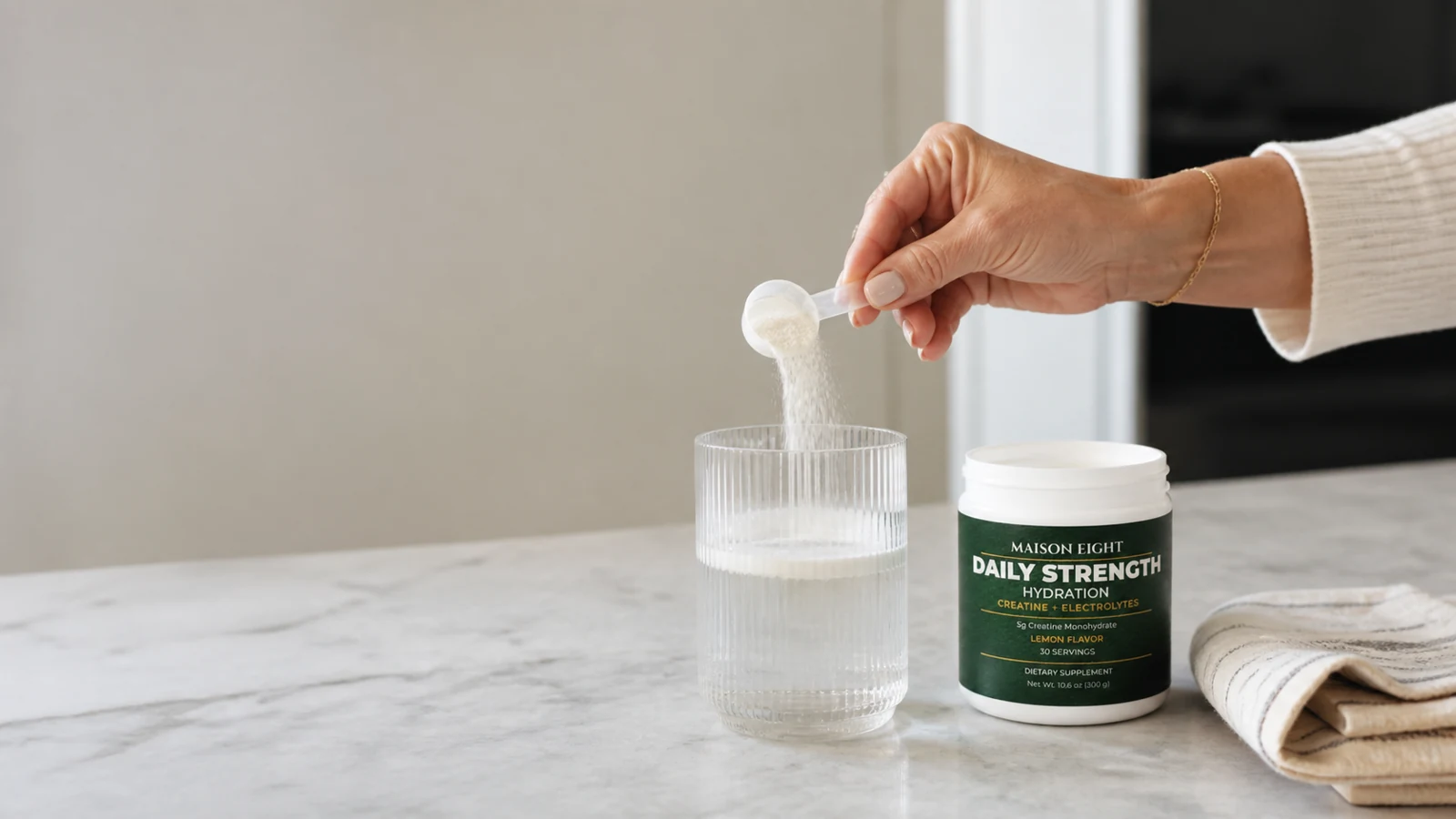
For women who decide creatine belongs in their routine, Maison Eight Daily Strength Hydration provides 5 g of creatine monohydrate with sodium, potassium and magnesium in a lemon-flavored daily scoop.
It combines ingredients for convenience; added electrolytes are not required for creatine supplementation to work. Plain creatine monohydrate is another option when creatine alone is the goal.
The current product label lists 1,000 mg of sodium per serving. Review that separately from your decision about creatine, particularly if you limit sodium or have been given mineral-intake advice.
No loading phase is required for normal daily supplementation. The formula does not replace protein, exercise or individualized care.
The bottom line
You do not need to earn a scoop of creatine with a workout. But the reason to take it should match the evidence: maintaining stores on rest days is well grounded; expecting the same muscle and strength benefits without training is much less certain.
Creatine can fit outside gym culture without becoming a substitute for using your muscles.
Publisher disclosure: Maison Eight previously sold creatine-containing supplements; product ordering is currently paused. Research discussed here concerns creatine and the specific interventions studied, not a clinical trial of Daily Strength Hydration.
Educational note: This article provides general nutrition information, not individualized medical advice. No medical-review credential is claimed.
References
- Harris and colleagues (1992): creatine uptake in resting and exercised muscle.
- Delpino and colleagues (2022): meta-analysis of creatine, exercise and lean body mass.
- Kreider and colleagues (2017): ISSN position stand on creatine mechanisms, use and safety.
- Sales and colleagues (2020): two-year creatine trial in postmenopausal women with osteopenia.
- Chun and colleagues (2026): creatine with and without exercise in middle-aged adults.
- CDC: aerobic and muscle-strengthening activity for adults.
- Gualano and colleagues (2014): randomized creatine and resistance-training trial in older women.
- Marshall and colleagues (2026): systematic review of creatine and cognition in older adults.
- EFSA (2024): scientific evaluation of creatine and cognitive function.
- Antonio and colleagues (2021): review of creatine misconceptions, including water and fat mass.
- Hultman and colleagues (1996): muscle creatine loading and decline after stopping.
- Longobardi and colleagues (2025): review of common creatine safety concerns.
- de Souza Almeida and colleagues (2026): meta-analysis of creatine and kidney measures.
- NIH Office of Dietary Supplements: creatine dosing and the role of dietary protein.
Daily routine
Do You Need to Work Out to Take Creatine?
In this article
Taking creatine without working out: three different situationsWhy exercise is not required for creatine to enter muscleWill creatine build muscle if you never strength train?Do women need gym workouts to benefit?Should you take creatine on rest days?Can creatine help your brain without exercise?Will creatine turn into fat if you do not work out?How much creatine do you take without working out?Is taking creatine without exercise safe?Is it worth taking if you do not exercise?Where Daily Strength Hydration fitsThe bottom lineReferencesStay in the loop
A little more clarity.
A little less noise.
Request new journal updates and practical supplement education, without another shopping commitment.