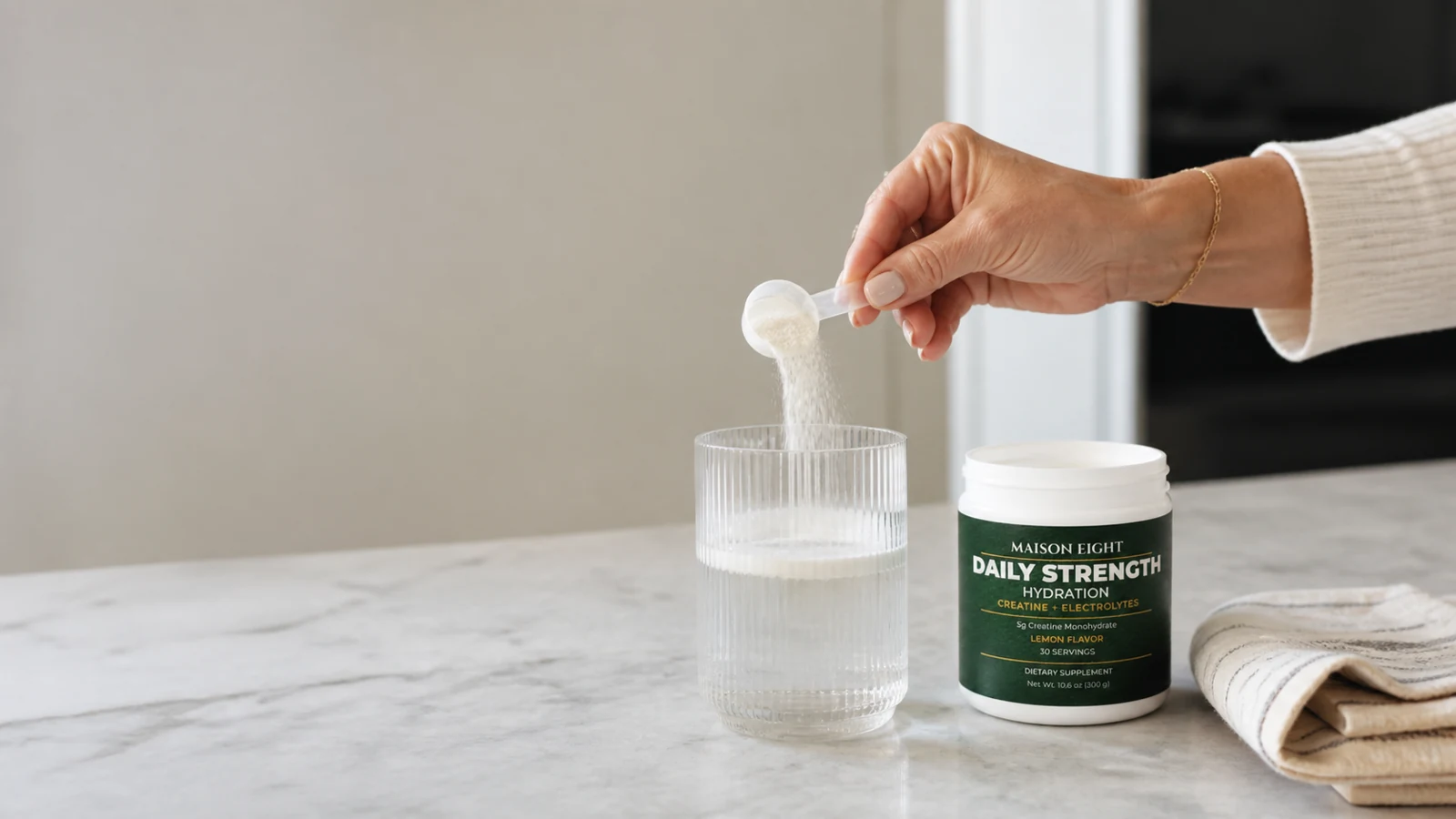
Creatine gummies, pills and powder should be compared by the complete daily serving—not by which format looks newer or more convenient. Check the form of creatine, grams per serving, number of gummies, capsules, tablets or scoops required, other ingredients, directions and evidence about the finished product. Research on creatine monohydrate does not automatically prove that every product contains its label claim. [1] [2]
Published October 4, 2026 · Updated October 24, 2026
The format can change how easy a product is to use. It does not create a women-specific version of creatine or erase the need to read the Supplement Facts panel.
Creatine gummies, pills or powder: the quick answer
| Question | Gummies | Pills or capsules | Powder |
|---|---|---|---|
| What is convenient? | Pre-portioned and no mixing, but a full serving may require several gummies. | Portable and no mixing, but a full serving may require several units and comfortable swallowing. | Usually one measured scoop mixed into a drink or food. |
| What must the label show? | Serving size in gummies and creatine amount for that full serving. | Serving size in capsules or tablets and creatine amount for that full serving. | Serving size in scoops or grams and creatine amount for that full serving. |
| What else can differ? | Sweeteners, sugars, acids, flavors, colors and gummy base. | Capsule shell or tablet binders, coatings, fillers and other listed ingredients. | Plain powders may have one ingredient; flavored blends can include several. |
| Which is proven better? | The evidence reviewed here does not establish a women-specific benefit or superior outcome from any delivery format. | ||
Powder is a practical default when you want flexible serving math or a short ingredient list. Gummies can suit someone who prefers a chewable format. Pills or capsules can suit someone who wants portability without sweetness or mixing and is comfortable taking the full number of units. Every choice still depends on the exact label and finished product.
What stays the same?
The best-studied supplemental form remains creatine monohydrate. The NIH Office of Dietary Supplements describes creatine as one of the most thoroughly studied exercise-performance ingredients and notes that common maintenance protocols use 3–5g per day after an optional loading phase. That is evidence about creatine supplementation—not proof that every product or serving format is equivalent. [1]
When gummies, pills and powder list creatine monohydrate, the front of the package still leaves important questions unanswered:
- How much creatine is in the full labeled serving?
- How many gummies, capsules or tablets—or how much powder—make that serving?
- What other ingredients come with it?
- Does any independent certification apply to that exact finished product?
- Can you follow the directions consistently without accidentally stacking creatine from another supplement?
For the underlying muscle-energy explanation, read what creatine actually does.
Creatine hydrochloride is a different creatine salt rather than a delivery format or particle-size label. Use the separate creatine HCl vs. monohydrate comparison for its solubility, dose and women-specific evidence limits.
Is micronized creatine different from creatine monohydrate?
Micronized creatine monohydrate is still creatine monohydrate. “Micronized” describes smaller powder particles; it does not name a different creatine compound or a women-specific formula. Finer particles can change how a powder disperses or feels in a drink, but a smoother-looking mixture is not proof of greater muscle uptake or better training results.
A 2022 critical review found no evidence that smaller-particle creatine monohydrate was more bioavailable than normal-mesh creatine monohydrate. [5] A newer 2026 trial of one branded micronized product reported higher plasma exposure and some better eight-week outcomes than one marketed comparator, but it does not establish an advantage for micronized creatine as a category: the pharmacokinetic phase involved 10 men, the training phase involved 52 men, the manufacturer funded the work and employed one author, and the study did not measure intramuscular creatine. [6]
For a label decision, keep the distinction narrow: micronized may be a practical mixing preference. Compare the same grams of creatine monohydrate per complete serving, the full ingredient list, directions, finished-product testing and cost. Do not pay a premium because “micronized” is presented as proven superior absorption, and do not assume the claim changes what women need.
What actually changes between gummies, pills and powder?
Routine
A gummy avoids a shaker, glass and scoop. A pill or capsule also avoids mixing, but the labeled serving may be several units. A powder can be mixed into a routine you already have. The more useful format is the one whose complete serving and directions you can follow—not the one with the stronger lifestyle claim.
Serving flexibility
Powder often makes it easier to measure a different amount when a qualified professional has advised one. Gummies, capsules and tablets divide the serving into fixed units. Do not assume that one unit equals one researched daily serving; the label may define a serving as several units.
Other ingredients
A plain creatine powder can contain only creatine monohydrate. Gummies need a structure and flavor system. Capsules need a shell, and tablets may use binders, coatings or other non-dietary ingredients; FDA labeling guidance requires these ingredients to appear in the ingredient statement. Flavored powders and multi-ingredient blends also require the same check. “Powder” does not automatically mean single-ingredient. [2]
Swallowing and total units
Pills and capsules add a decision that gummies and powder do not: whether you can comfortably take every unit in the labeled serving. Compare the full serving count and directions before buying. A bottle's total capsule or tablet count is not its number of daily servings when one serving requires multiple units.
Cost per complete serving
Compare the price for the number of gummies, pills or scoops that provide the labeled daily amount. Cost per container can mislead when two containers hold different numbers of complete servings.
Is dry scooping creatine safe or useful?
Dry scooping adds avoidable choking and inhalation risk without a proven absorption or effectiveness advantage. Measure the labeled serving and take powder in the way the product directs—normally mixed into liquid or food—rather than tipping a dry scoop into your mouth.
Poison Control and an American Academy of Pediatrics report warn that swallowing a concentrated mouthful of supplement powder can trigger coughing, choking or accidental inhalation. Their reports focus on multi-ingredient pre-workout products, not plain creatine monohydrate, so caffeine-related heart effects from those products should not be attributed to creatine. The physical powder risk and the instruction to use a product as directed are the relevant lessons here. [8] [9]
There is also no evidence that keeping creatine dry in the mouth creates a shortcut to better results. In one small pharmacokinetic study, creatine swallowed as a crushed lozenge or as a cold crystalline suspension produced a lower peak and a smaller six-hour blood-exposure area than the same amount in solution. The study did not test a modern dry-scooping routine, women, muscle creatine or training outcomes, so it does not prove that dry scooping is less effective. It does directly reject an assumed absorption advantage. [10]
If mixed powder settles, stir or rinse the glass so you finish the measured serving; do not compensate with another scoop. The mixing guide explains why a perfectly clear drink is unnecessary, while the hydration guide separates serving liquid from total daily water needs.
Can you travel with creatine?
For travel within or departing from the United States, TSA lists protein or energy powders as allowed in both carry-on and checked bags. Powder-like substances larger than 12oz/350mL in a carry-on can require separate screening, and the container may be opened. If officers cannot resolve the powder during screening, it may not be allowed through the checkpoint; the final decision rests with the TSA officer. [7]
That is a screening rule, not a promise that every airport or country uses the same process. Check the rules for the departure, connection and destination countries before an international trip. Keeping the supplement sealed and clearly labeled can make identification easier, but the TSA guidance reviewed here does not say creatine must stay in its original retail tub.
- Powder: pack only what you need in a dry, tightly closed container, protect it from spills and keep the scoop dry. Dry creatine monohydrate is stable; do not turn that ingredient evidence into a shelf-life claim for every flavored or multi-ingredient product. [5]
- Pills or gummies: these avoid powder screening and mixing, but you still need the full labeled number of units and the product's storage directions.
- Prepared drinks: airport liquid rules, chemical stability and food safety are separate questions. The premixing guide explains why a same-day bottle is not evidence for an overnight or multi-day prepared drink.
If travel interrupts the routine, an occasional missed dose does not empty muscle creatine stores overnight. Use the product's usual directions rather than doubling the next dose to catch up; the rest-day guide owns that dosing question and its evidence.
Does creatine expire or go bad?
Dry creatine monohydrate is chemically stable, but that does not make every old or opened supplement automatically suitable to use. Controlled ingredient data found no measurable conversion to creatinine after more than three years at temperatures up to 40°C (104°F). That result applies to dry creatine monohydrate under the tested conditions—not to a wet scoop, damaged seal, flavored blend, gummy, capsule or ready-to-drink product. [5]
In the United States, FDA guidance says a dietary supplement is not required to carry an expiration date. If a company chooses to print one, the date must be supported by valid data and must not be false or misleading. [11] Use the date and storage directions on the exact product you have; do not replace them with a universal “one or two years after expiration” rule borrowed from plain-ingredient research.
- Keep powder dry and tightly closed. Use a dry scoop and follow the container's storage directions. Opening the lid does not create one universal countdown, but moisture and damaged packaging move the question beyond dry-powder stability.
- Do not use appearance alone as a potency test. Clumping can show that powder has encountered moisture, but it cannot verify ingredient amount, contamination status or finished-product shelf life.
- When the container or product seems compromised, replace it or ask the manufacturer. A broken seal, water intrusion, visible growth, unusual color or unexpected odor is not made acceptable by evidence that pure dry creatine is stable.
Daily Strength Hydration is a flavored, multi-ingredient finished product. Plain creatine-monohydrate stability data do not establish its shelf life after manufacture or opening. Follow its own label when available. For powder already mixed into a drink, use the separate premixing guidance; dissolved creatine, food safety and dry-container storage are different questions.
How to compare the full serving
The FDA requires a dietary supplement label to state serving size, servings per container and dietary ingredients. For tablets and capsules, the serving size is a number of units; if directions say to take more than one at an eating occasion, the full recommended amount determines the serving size. Except for ingredients within a permitted proprietary blend, the Supplement Facts panel provides the amount per serving. [2]
- Find the serving size. Write down the number of gummies, capsules, tablets, scoops or grams—not the amount you assume you would take.
- Find the creatine form and amount. Look for creatine monohydrate and the grams supplied by that complete serving. Do not confuse total gummy weight, scoop weight or a front-label number with grams of creatine.
- Count the real servings. Divide the total units by the units required per serving. A bottle with 90 gummies contains 30 servings if the serving size is three gummies; the same calculation applies to capsules or tablets.
- Read the directions and other ingredients. Note whether the formula includes caffeine, electrolytes, sugars, sweeteners or another supplement you already use.
- Add overlapping products. If a pre-workout, protein blend or hydration mix also contains creatine, count that amount rather than treating each label as a separate routine.
If a label hides the creatine amount inside a proprietary blend, you cannot determine the exact grams from the panel. A women-focused name, shape or flavor does not solve that information gap.
What can independent testing tell you?
Testing language is easy to overread. Separate these claims:
- A finished-product certification applies to the named product under a specific program. NSF explains that Certified for Sport includes formulation and label review, product testing, facility and supplier inspections, and ongoing monitoring, including banned-substance screening. [3]
- A public certification listing lets you confirm that the exact product and format are currently listed. A brand may have one certified product without every item it sells being certified.
- A certificate of analysis describes the sample and tests on that report. Check the product name, lot, date, laboratory, measured amount and whether the report covers the finished product rather than only a raw ingredient.
- GMP or facility language concerns manufacturing systems. It is not the same as a finished batch being independently verified for its full label claim.
Certification can add a useful quality check. It does not prove that gummies, pills or powder outperform one another, or that a supplement will produce a particular result for you. Likewise, research on an ingredient cannot be presented as a clinical trial of a finished product.
Do women need a different creatine format?
No women-specific delivery format has been established as necessary. Female-specific creatine research spans varied doses, sports and training contexts, and the 2026 meta-analysis describes low or very-low certainty for several pooled outcomes. It does not establish a gummy, pill or powder advantage. [4]
A format preference can still be personal and practical. Taste, swallowing, portability, ingredient preferences, budget and the ability to take the complete serving all matter. Those are product-choice factors, not evidence that one delivery format is better for female hormones or more “serious.”
Women over 40 who want the life-stage evidence and its limits can use our creatine guide for women over 40. That page owns dosing, perimenopause, postmenopause, training and safety context; this page owns the delivery-format decision.
A practical decision rule
Choose between actual labels using this order:
- Clear creatine form and grams per complete serving.
- A serving you will realistically take as directed.
- Other ingredients that fit your needs and restrictions.
- Finished-product evidence or certification you can verify.
- Cost per complete serving, not price per bottle.
If two products pass those checks, convenience can decide. If one does not disclose enough information to calculate the serving, its format does not rescue it.
Where Daily Strength Hydration fits
Maison Eight Daily Strength Hydration is a powder, but it is not plain creatine. One scoop lists 5g creatine monohydrate plus sodium, potassium and magnesium. Those added minerals are separate label facts; they do not make electrolytes necessary for creatine absorption or prove that the finished combination outperforms plain creatine.
Review the complete formula, Supplement Facts and current availability. The product is temporarily unavailable. Joining the waitlist requests availability updates; it is not a purchase, order or reservation.
The bottom line
Gummies can suit chewable convenience, pills can suit no-mix portability, and powder can suit serving flexibility or simpler formulations. No format should be judged by that generalization alone.
Read the full serving, confirm the grams of creatine monohydrate, account for every unit and extra ingredient, and verify any testing claim against the exact finished product. The useful question is not “Which format is better for women?” It is “Which complete product gives me clear, verifiable information and a routine I can actually follow?”
Sources
Sources checked October 24, 2026. Written by Maison Eight. Ingredient and format research discussed here is not a clinical trial of Daily Strength Hydration.
- NIH Office of Dietary Supplements. Dietary Supplements for Exercise and Athletic Performance — Health Professional Fact Sheet. Creatine forms, evidence and commonly studied protocols.
- U.S. Food and Drug Administration. Dietary Supplement Labeling Guide: Chapter IV. Nutrition Labeling. Supplement Facts, serving-size, per-unit and non-dietary ingredient-label requirements.
- NSF. Certified for Sport program. Product testing, formulation and label review, facility inspections and ongoing monitoring.
- Lin Y, Zhu W, Hong B. Effects of creatine supplementation on exercise performance, physiological outcomes, and body composition in females engaged in exercise or training: a systematic review and multilevel meta-analysis. Frontiers in Nutrition. 2026.
- Kreider RB, Jäger R, Purpura M. Bioavailability, Efficacy, Safety, and Regulatory Status of Creatine and Related Compounds: A Critical Review. Nutrients. 2022. Review of creatine forms, including normal- and smaller-particle creatine monohydrate.
- Aggarwal P, Agarwal R. Comparative Efficacy and Pharmacokinetic Parameters of Micronized Creatine Monohydrate (KleanCREATINE™) in Active Men: A Randomized, Controlled Clinical Study. Cureus. 2026. Branded, company-funded male trial with short duration and no intramuscular-creatine measurement.
- Transportation Security Administration. Protein or Energy Powders. Carry-on and checked-bag status, additional screening for larger carry-on powders and TSA-officer discretion.
- National Capital Poison Center. Dry scooping can be life-threatening. Choking and breathing risks from swallowing concentrated pre-workout powder; the stimulant-specific harms discussed there do not establish harms from plain creatine.
- Lin A, Chow N. Dry Scooping and Other Dangerous Pre-workout Consumption Methods: A Quantitative Analysis. Pediatrics. 2022 meeting abstract. Concentrated-powder choking and inhalation context; not a creatine-specific outcome study.
- Harris RC, et al. Absorption of creatine supplied as a drink, in meat or in solid form. Journal of Sports Sciences. 2002. Small pharmacokinetic comparisons of creatine in solution, meat, a crushed lozenge and a cold suspension; no women-specific or training outcome comparison.
- U.S. Food and Drug Administration. Dietary Supplement Labeling Guide: Chapter I. General Dietary Supplement Labeling. Expiration dating is not required for dietary supplements; a voluntarily stated date must be supported by valid data and not be false or misleading.